
7 Signs Your Business Is Ready for Tax Planning
You had a good year. Sales are up, customers are calling, and you may even be thinking about hiring another employee. Then tax season arrives, and you find out how much you owe. The question you want answered is usually the same: “Could we have done something about this sooner?”
Sometimes, yes. But the frustrating part is that the best time to ask may have been months earlier—before you bought equipment, changed your payroll, or took money out of the company.
That’s the difference between preparing a tax return and planning for taxes. A return reports what already happened. Tax planning gives you a chance to understand the consequences of what you’re about to do.
Quick answer: When does a business need tax planning?
Your business may be ready for proactive tax planning when profits are growing, tax bills keep catching you off guard, you are paying yourself through an LLC or S corporation, you are considering major purchases or hiring, your business finances are becoming more complicated, or you have no reliable estimate of what you will owe. You do not have to be a large company to benefit. You do need dependable records and enough time to act before relevant deadlines.
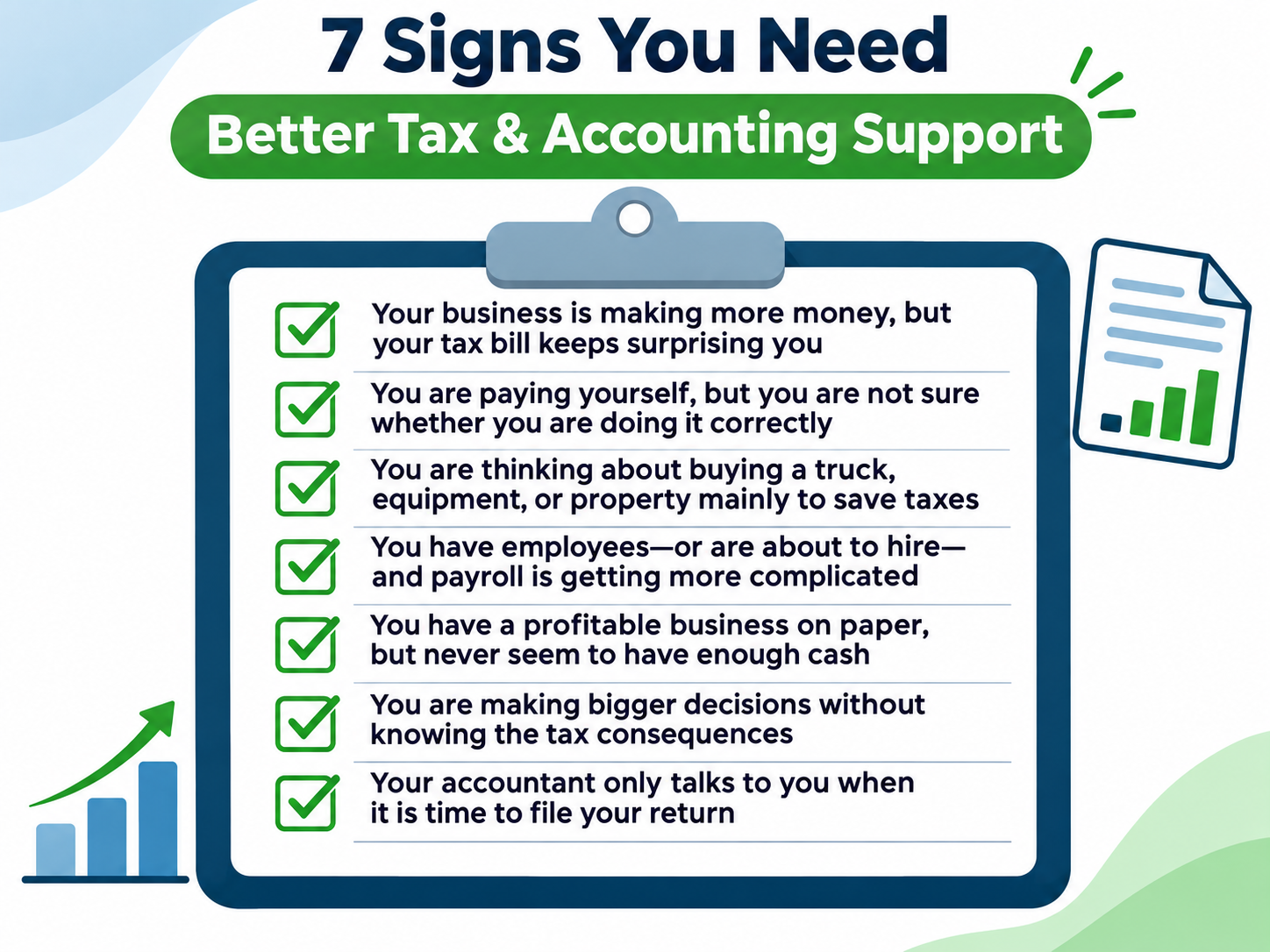
1. Your business is making more money, but your tax bill keeps surprising you
An unexpected tax bill once might be a timing issue. If it happens year after year, it is a sign that your business needs a better process. Maybe you earned more than you expected. Maybe estimated payments never kept pace with profits. Or maybe you took distributions and assumed the business had already covered the tax.
Consider an owner whose business profit rises from $90,000 to $160,000. That is good news—but if estimated tax payments were based on last year, the owner may face a significant balance due. The exact tax depends on the entity, other household income, deductions, credits, state taxes, and payments already made.
A planning meeting can turn the surprise into a forecast. You review year-to-date profit, project the rest of the year, estimate federal and state tax exposure, and decide what to reserve or pay. You may also review applicable estimated-tax safe harbors to reduce penalty risk.
What to ask: “Based on where the business stands today, what might I owe, and how much should I set aside each month?”
2. You are paying yourself, but you are not sure whether you are doing it correctly
Owners often move money from the business to their personal account whenever cash is available. That may be a distribution, a draw, payroll, a loan repayment, or something else. The tax treatment depends on the business structure and the facts—not the description entered in QuickBooks.
For example, an owner working in an S corporation must receive reasonable W-2 compensation for services provided before taking additional non-wage distributions. There is no IRS-approved salary percentage that fits everyone. The analysis considers duties, time spent, experience, and comparable compensation. An owner draw from a sole proprietorship, by contrast, is not a deductible business expense.
Planning can help you review reasonable compensation, payroll deposits, shareholder basis, distributions, benefits, and cash requirements before the final payroll runs. It can also help you determine whether a change in tax classification deserves a closer look—without assuming an S corporation election always saves money.
What to ask: “Does the way I pay myself make sense for my business structure, and can I support it?”
3. You are thinking about buying a truck, equipment, or property mainly to save taxes
We hear some version of this every year: “Should I buy another truck before December 31 so I can write it off?” Maybe. But that question starts in the wrong place. First ask whether the business needs the truck and whether the purchase will produce enough value to justify the cash and financing.
Year-end tax planning for equipment purchases may affect the timing of a deduction, but eligibility and limits depend on the asset, business use, tax year, and when the property is placed in service. A deposit or signed contract does not automatically create a current-year deduction.
Example: A deduction does not make a purchase free
| Illustrative equipment purchase | $60,000 |
| Assumed eligible current-year deduction | $60,000 |
| Assumed combined marginal tax benefit (25%) | $15,000 |
| Cash cost after illustrative tax benefit | $45,000 |
This example is deliberately simplified: the actual deduction, tax savings, cash timing, and state treatment may differ. Spending $60,000 to save $15,000 is not a win if the equipment sits unused or leaves you short on payroll.
What to ask: “Would I still make this purchase if there were no immediate tax deduction?”
4. You have employees—or are about to hire—and payroll is getting more complicated
Adding employees can be a great sign of growth. It also changes the numbers. Employer payroll taxes, benefits, workers’ compensation, retirement plan rules, and administrative costs all affect the decision. Hiring in another state can add registration, withholding, and other compliance requirements.
If you operate an S corporation, payroll planning also touches owner wages and certain shareholder benefits. If you are considering a retirement plan, setup dates, employee eligibility, salary-deferral elections, and employer contribution deadlines vary by plan. Some decisions cannot be made retroactively.
Tax planning is not a substitute for a hiring budget. It helps you understand how payroll, benefits, retirement contributions, and taxes interact so you can make the decision with your eyes open.
What to ask: “What will this employee really cost, and which payroll and benefit decisions need to happen before year-end?”
5. You have a profitable business on paper, but never seem to have enough cash
You can have taxable income and still be staring at a thin bank balance. Customers may owe you money. You may have paid down a loan, bought inventory, purchased equipment, or taken owner distributions. Those cash movements do not necessarily reduce taxable income in the same way.
Suppose the company reports $120,000 in profit, but customers still owe $45,000 and you paid $30,000 of loan principal. Neither number automatically tells you what the tax return will show, but both can explain why cash feels tighter than profit suggests.
This is where tax planning and accurate financial reports need to work together. A useful advisor should help you understand projected tax obligations while you build a cash reserve for payroll, slow seasons, debt payments, and taxes. Paying less tax is not helpful if the strategy creates a cash crisis.
What to ask: “How much cash is truly available after taxes and the obligations we already have?”
6. You are making bigger decisions without knowing the tax consequences
Maybe you want to bring in a partner, open a second location, purchase a building, change how the business is taxed, or start investing more aggressively for retirement. These decisions can have consequences well beyond this year’s return.
A change in ownership can affect basis, allocations, agreements, and future exits. A new location may create state and local tax obligations. A business property purchase raises financing, depreciation, and entity-ownership questions. Retirement plan options depend on the workforce and plan rules, not just how much the owner wants to contribute.
You do not need a complicated tax maneuver every time you grow. You need to know which decisions are difficult or expensive to undo—and get advice before you sign.
What to ask: “What should I know about taxes, cash flow, and future flexibility before I commit?”
7. Your accountant only talks to you when it is time to file your return
This one is easy to overlook because the tax return may be prepared accurately and on time. But if the only conversation happens after the year is over, your accountant may be reporting the results of decisions you never had a chance to evaluate.
A year-round tax planning relationship usually involves reviewing reliable financial statements, projecting taxable income, identifying opportunities and risks, and agreeing on action items before deadlines. It should also include a realistic conversation about fees and scope: tax return preparation and ongoing planning are often separate services.
Not every business needs a meeting every month. Many benefit from a midyear projection and a fall or early-winter update, with additional conversations before major decisions. Businesses with rapid growth or complicated operations may need more frequent reviews.
What to ask: “When will we review my tax position before year-end, and what decisions should I make before then?”
What a real tax planning meeting should accomplish
A useful meeting should not be a list of clever deductions with no explanation. You should leave understanding your projected tax position, which opportunities actually apply, how much cash they require, the risks and trade-offs, and the deadlines for taking action.
- Review year-to-date profit and loss, balance sheet, and expected year-end results.
- Estimate federal and state tax exposure using the owner’s full relevant tax picture.
- Review entity classification, owner compensation, distributions, and benefits where applicable.
- Evaluate planned purchases, financing, retirement contributions, and employee-related decisions.
- Identify documentation requirements and deadlines, including items that cannot be fixed after year-end.
- Assign each action an owner and a date; schedule a follow-up to confirm completion.
One important point: not every planning meeting produces an immediate tax saving. Sometimes the value is avoiding a penalty, preserving cash, choosing not to make an unnecessary purchase, or preventing a costly payroll mistake.
A simple example: Two owners, the same profit, very different experiences
Two service business owners each expect $180,000 in annual profit. One waits until the return is prepared to ask about taxes. The other reviews financial statements in September, updates a projection, considers whether owner payroll and retirement arrangements are appropriate, and begins setting aside cash for the expected bill.
They may ultimately owe similar amounts of tax. But the second owner has time to compare options, meet deadlines, and avoid scrambling for cash. That is the point of planning: better decisions, not a promise that every strategy will cut the tax bill.
Are you ready? A quick business-owner checklist
If you checked even one box, there may be a worthwhile conversation to have. It does not automatically mean you need an elaborate tax strategy. It means there is a decision or risk that deserves attention before the next filing deadline.
Frequently Asked Questions
Stop finding out what you owe after your options have narrowed
You have enough decisions to make as a business owner. Your tax bill should not be one more surprise you only learn about when the return is ready. If your company is growing, your income is changing, or you are making important financial decisions, the right time to talk is before those decisions are final.
Profit Wise Accounting & Tax works with small business owners who want to understand the numbers behind their business and make thoughtful tax decisions throughout the year. We can help evaluate whether proactive tax planning makes sense for your situation and identify what information is needed to begin.
Let’s review where your business stands, what decisions are coming up, and which tax planning opportunities or risks deserve attention—while there is still time to act.
Educational information only. Tax results depend on individual facts, applicable law, and the relevant tax year; this article is not a substitute for advice on a specific situation.