
How Business Owners Can Legally Reduce Their Tax Bill
Everything Business Owners Need to know
By: Sharon Heinz, EA,
Date Posted: August 2026
Reading Time: 8 – 10 Minutes
Learn how profitable business owners can legally reduce their tax bill with strategic tax planning, smart deductions, and proactive tax strategies. Business owners don’t reduce taxes by waiting until their tax return is prepared. They reduce taxes by making informed decisions throughout the year. In this guide, we’ll look at practical ways business owners can proactively plan for their taxes and make informed decisions before tax season arrives.
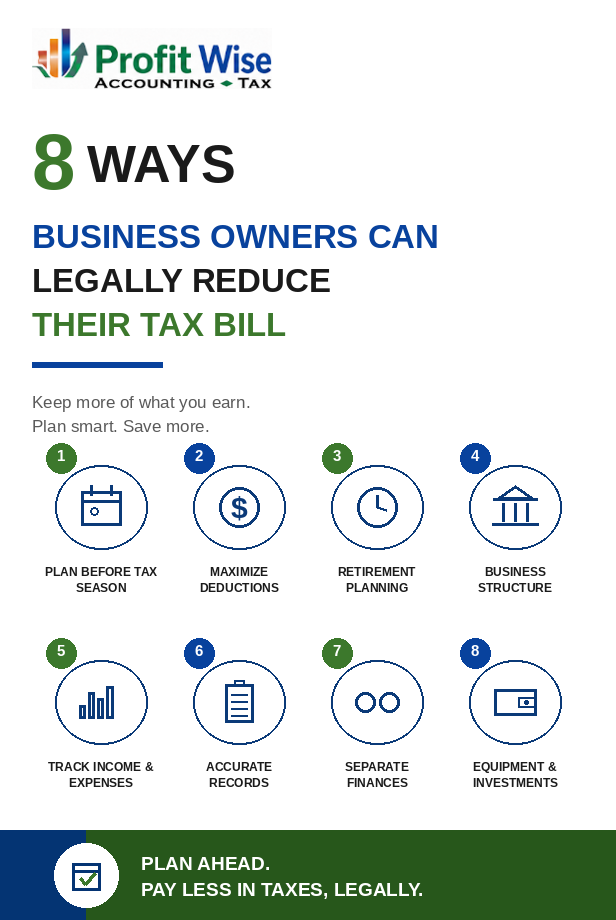
Here are 8 tips you can follow if you are interested in legally reducing your tax bill as a business owner:
1) Plan before tax season
October can be a great time for a year-end tax strategy meeting because you have enough information about the year’s performance to make a meaningful projection, while still having time to make certain decisions before year-end. Meet with your accountant in advance, so you have time to discuss things like:
- Are there legitimate business expenses they haven’t accounted for?
- Are there equipment or technology purchases the business already needs?
- Should they consider a retirement plan or additional contributions?
- Are their estimated tax payments appropriate?
- Does their current business structure still make sense?
- Are there tax credits they may qualify for?
- Should certain income or expenses be timed differently?
- What will their tax liability look like if they make different business decisions?
Having tax strategy meetings before the tax season ends can give you time to catch mistakes and optimize your tax return.
2) Maximize legitimate deductions
Maximizing deductions does not mean finding ways to make personal expenses look like business expenses. If you are maximizing legitimate deductions, this should look like–
- Keeping accurate records of business expenses
- Having separate business and personal spending credit cards
- Understanding what qualifies as a business expense
- Looking for deductions the owner may be overlooking (Be sure to check all tax rules)
- Planning purchases instead of making unnecessary purchases
- Keeping documentation
3) Retirement planning
Retirement planning can help a business owner legally reduce their tax liability because certain retirement contributions may be deductible or otherwise receive favorable tax treatment. The goal is to find a retirement strategy that makes sense for both your financial future and your current tax situation. To specify, retirement planning is not providing “a tax break”, but redirecting money toward retirement while potentially receiving tax benefits; some retirement situations that provide such opportunities include, traditional 401(k) contributions, employer contributions, SEP IRA for a small business, simple IRA, setting up a retirement plan for the first time, etc.
4) Review business structure
Reviewing your business structure can potentially reduce a business owner’s tax bill because different business structures can be taxed differently. Before the tax season starts, profitable business owners should ask:
“Does my current business structure still make sense for where my business is today?”
Business owners commonly operate as sole proprietorships, partnerships, LLCs, S corporations, or C corporations. Each structure has different tax rules, legal considerations, and administrative requirements.
A sole proprietorship is generally the simplest business structure. Business income and expenses are typically reported on the owner’s individual tax return, and the owner generally pays income and self-employment taxes on business earnings. An LLC provides a legal business structure, but “LLC” doesn’t automatically determine how the business is taxed. Depending on the circumstances, an LLC can be taxed as a sole proprietorship, partnership, S corporation, or C corporation. An eligible business can elect to be taxed as an S corporation. For some profitable business owners, this may create an opportunity to structure compensation between wages and distributions. An eligible business can elect to be taxed as an S corporation. For some profitable business owners, this may create an opportunity to structure compensation between wages and distributions. The IRS requires shareholder-employees who provide services to the corporation to receive reasonable compensation for those services. The appropriate amount depends on the facts and circumstances of the business and the owner’s role. A C corporation is a separate taxpaying entity. Unlike pass-through structures, the corporation generally pays income tax on its taxable income, and shareholders may also have tax consequences when profits are distributed as dividends.
Business structure is one of the areas where a profitable business owner can benefit from having an actual tax-planning conversation, rather than simply looking for deductions.
5) Time, Income and Expenses
When your business is profitable, the timing of certain business decisions can affect your tax situation. That’s why it’s important to think about the tax consequences before making major purchases or financial decisions.
For example, imagine your business is having a particularly profitable year and you know you need to purchase $20,000 of new equipment. You could purchase the equipment in December, or you could wait until January. Depending on your business’s accounting method and the applicable tax rules, purchasing the equipment before the end of the year could potentially allow you to receive a tax benefit sooner rather than waiting until the following year.
The goal is to make smart business decisions with the tax consequences in mind.
6) Keep accurate financial records
Keeping accurate financial records comes in handy when you need to properly claim deductions. The better information you have, the easier it will be for tax planning and reducing your tax bill.
For example, imagine a profitable business spends $25,000 throughout the year on advertising, software, professional services, business insurance, and other legitimate business expenses. If those expenses aren’t properly recorded in the accounting system, the business could overlook deductions it may otherwise be entitled to claim.
Keeping accurate financial records also prevents another common problem that is covered next: Mixing personal and business expenses.
7) Separate business/personal finances
Keeping your business and personal finances separate may seem like a basic bookkeeping rule, but it can also play an important role in your overall tax strategy. Keeping accurate financial records overlaps with this topic, but when discussing the need to keep separate business/personal finance think about:
“Where does the money go?”
Separate finances is all about organization and accurate records is all about documentation; however, separating your accounts does not create a deduction–it is about making your business transactions clearly identifiable, so that a deduction is easier to find if there is one. As a reminder, common business expenses include employee payroll, professional services (accounting or tax prep), marketing, technology (software or CRM), office expenses, travel expenses, professional development, etc.
8) Review equipment/investments
Major business purchases can have tax consequences, so profitable business owners should consider the tax impact before making significant investments. This topic does overlap with Time, Income and Expenses; however, the main difference is Reviewing equipment/Investments focuses on What you are buying and how you treat that purchase, and Time, Income and Expenses focuses on When you recognize something for tax purposes.
When it comes to reviewing your equipment, depending on the type of asset, how it is used, when it is placed in service, and the tax rules that apply, the purchase may be subject to depreciation or other tax provisions that can affect when and how the cost impacts your taxable income.
This is especially important for profitable businesses because a major purchase can represent a significant amount of money. Understanding the tax consequences before making the investment allows you to make the decision based on the business benefit, cash flow, and potential tax impact—rather than discovering the tax consequences after the purchase has already been made.
Don’t Wait Until Tax Season to Think About Your Taxes
Are you ready to take the next step? Reducing your tax bill legally is about planning ahead and making informed decisions while you still have options. The key is timing. By the time you’re sitting down to prepare your tax return, the tax year has already ended. Many of the decisions that could have affected your tax situation may already be behind you.
That’s why tax planning should happen before tax season—not after it.
If your business is profitable, don’t wait until you receive your tax bill to find out what you could have done differently. A proactive review can help you understand your projected tax liability and identify strategies worth considering before the year ends.
At Profit Wise, our Strategic Tax Planning approach is designed to help business owners look beyond tax preparation and make informed decisions about their business and taxes throughout the year.
About The Author
Sharon Heinz, EA, is the owner of Profit Wise Accounting. Profit Wise provides tax preparation, strategic tax planning, accounting, bookkeeping, payroll, and business advisory services for small and growing businesses.