
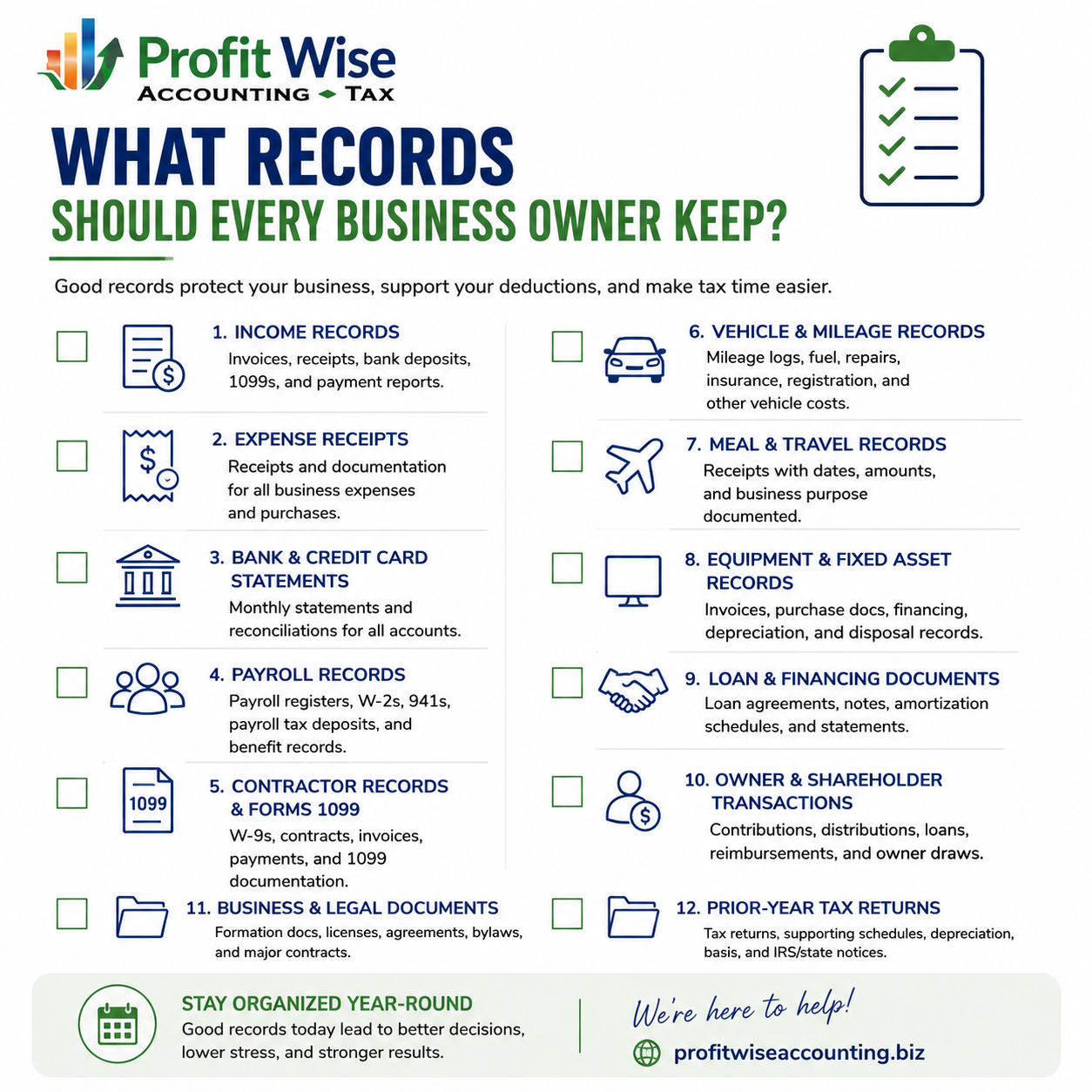
What Records Should Every Business Owner Keep?
A Small Business Recordkeeping Guide
By: Sharon Heinz, EA
Date Posted: August 2026
Reading Time: 10 – 15 Minutes
Good recordkeeping isn’t just about being ready for tax season. It protects your deductions, supports your tax return, helps you understand your business, and makes tax planning significantly easier.
One of the most common problems we see with business owners isn’t necessarily that an expense wasn’t deductible. It’s that the business owner can’t adequately document it.
Receipts disappear. Mileage isn’t tracked. Business purchases are made on personal cards. Loan documents aren’t saved. Equipment purchases get buried among ordinary expenses. By tax season, everyone is trying to reconstruct what happened months earlier.
A better approach is to create a recordkeeping system during the year. Here are the records every business owner should consider maintaining.
1) Business Income Records
Maintain records showing the income your business receives and where that income came from. Depending on your business, these may include customer invoices, sales receipts, bank deposit records, merchant processor reports, Forms 1099, online payment platform reports, e-commerce reports, accounts receivable reports, contracts, and sales agreements.
Your accounting records should reconcile with your actual business activity. This is especially important when amounts reported on Forms 1099 do not appear to match the revenue recorded in your books.
2) Business Expense Receipts and Documentation
If your business claims an expense, maintain documentation supporting what was purchased and why it was a business expense.
Examples include office supplies, software subscriptions, advertising, professional fees, insurance, repairs, business travel, continuing education, equipment, business meals, vehicle expenses, and telephone or internet expenses.
A bank or credit-card statement can show that money was spent, but it may not explain what was purchased or the business purpose. Good records should establish who was paid, how much was paid, when it was paid, what was purchased, and why it was business-related.
3) Bank and Credit-Card Statements
Business bank and credit-card statements should be retained and reconciled regularly. Ideally, your business should maintain dedicated business accounts rather than mixing personal and business activity.
Keep records for business checking and savings accounts, business credit cards, lines of credit, merchant accounts, and payment-processing accounts.
Monthly reconciliation helps identify missing transactions, duplicates, incorrect amounts, unusual activity, and bookkeeping errors before they become year-end problems.
4) Payroll Records
If you have employees, payroll documentation is particularly important. Records may include payroll registers, employee wage information, Forms W-2 and W-3, Forms 941, state payroll filings, payroll tax deposits, employee benefit information, retirement contributions, paid-time-off records, and employee reimbursements.
For S-Corporation owners, payroll records also help document shareholder-employee compensation. Payroll should reconcile with the accounting records and payroll tax returns filed throughout the year.
5) Contractor Records and Forms 1099
If your business pays independent contractors or certain other vendors, maintain documentation throughout the year rather than waiting until January.
That may include Forms W-9, contractor agreements, invoices, payment records, certificates of insurance when appropriate, and Forms 1099 issued by the business.
Obtaining a completed Form W-9 before or when you begin paying a contractor is much easier than trying to locate the contractor after the year has ended.
6) Vehicle and Mileage Records
If you use a vehicle for business, maintain a contemporaneous mileage record that includes the date, destination, business purpose, and business miles driven.
Depending on the deduction method used, you may also need records for fuel, repairs, insurance, registration, lease payments, vehicle purchase documents, interest, and other operating costs.
Trying to estimate an entire year’s business mileage during tax preparation is not a strong recordkeeping system. Use a mileage-tracking app or another consistent method throughout the year.
7) Business Meal and Travel Records
Meals and travel can require additional documentation because personal and business activities can overlap.
For business meals, retain the date, amount, location, business purpose, and individuals involved when relevant. For travel, retain airline receipts, hotel bills, rental-car receipts, transportation costs, conference registrations, itineraries, and documentation supporting the business purpose.
Simply having a receipt does not always establish that an expense was business-related.
8) Equipment and Fixed-Asset Purchases
When your business purchases equipment, furniture, computers, machinery, vehicles, or other significant assets, save the complete purchase documentation.
Keep purchase invoices, purchase agreements, financing documents, the date placed in service, asset descriptions, trade-in information, records of improvements, and eventual disposal or sale documentation.
These records can affect depreciation, Section 179 deductions, gain or loss when an asset is sold, and the company’s balance sheet.
9) Loan and Financing Documents
Maintain copies of loan agreements, promissory notes, closing documents, amortization schedules, year-end loan statements, lines-of-credit agreements, and equipment financing agreements.
A loan payment usually contains both principal and interest. Those amounts have different accounting and tax treatment. Without proper documentation, the loan balance shown in QuickBooks can easily become inaccurate.
10) Owner and Shareholder Transactions
Business owners should carefully document money moving between themselves and the business.
Depending on the entity, these transactions could include owner contributions, owner draws, shareholder or partner distributions, shareholder loans, loans from the business to an owner, business expenses paid personally, reimbursements, and capital contributions.
These transactions should not automatically be categorized as income or business expenses. For S Corporations and partnerships, accurate records can also be important when determining shareholder or partner tax basis.
11) Business Formation and Legal Documents
Some records should be maintained as part of the company’s permanent business file. These may include articles of organization or incorporation, EIN confirmation, operating agreements, corporate bylaws, S-Corporation election documentation, partnership agreements, ownership agreements, business licenses, major contracts, purchase or sale agreements, and ownership-change documentation.
12) Prior-Year Tax Returns
Maintain complete copies of business tax returns and important supporting documentation, including federal and state income tax returns, payroll tax returns, sales-tax returns, Forms 1099, depreciation schedules, fixed-asset schedules, basis schedules, carryforward information, and tax notices or correspondence.
A tax return contains historical information that may affect future years. A new tax professional may need information from several prior years to prepare the current return correctly.
How Long Should Business Records Be Kept?
There is no single retention period that applies to every business document. The appropriate period depends on the type of record and why it may be needed.
Tax records generally should be retained long enough to support the income, deductions, and other items reported on a tax return for the applicable limitation period. Some documents should be retained significantly longer.
Records involving property and depreciable assets may need to be maintained throughout the ownership period and beyond the eventual disposition. Payroll and employment records can have separate requirements. Core organizational documents, ownership records, and certain legal agreements should generally be maintained permanently.
When there is uncertainty, do not destroy a business record simply because the related tax return has already been filed.
Digital Records Are Fine—If You Can Find Them
You don’t necessarily need filing cabinets full of paper. A well-organized digital recordkeeping system can be much more efficient.
The important issue is whether documentation is complete, secure, backed up, and retrievable. Consider organizing documents by Year → Category → Month and using descriptive file names.
The goal is simple: if your accountant asks for documentation two years from now, can you locate it quickly?
Keep Business and Personal Finances Separate
One of the easiest ways to improve business recordkeeping is to separate business and personal activity.
Whenever possible, use dedicated business bank accounts and credit cards, deposit business income into business accounts, pay business expenses from business accounts, properly record owner contributions and withdrawals, and use a formal reimbursement process for qualifying expenses paid personally.
Mixing personal and business transactions creates additional bookkeeping work and increases the possibility that expenses will be missed or categorized incorrectly.
Good Records Make Better Tax Planning Possible
Recordkeeping isn’t only about proving deductions. Accurate records create accurate books. Accurate books create reliable financial statements. Reliable financial statements allow your accountant to provide better tax planning and business advice.
When your accounting records are current, conversations can focus on projected taxable income, estimated tax payments, retirement contributions, S-Corporation compensation, equipment purchases, cash flow, profitability, year-end deductions, and business growth.
When the books are incomplete, the first conversation has to be about fixing the numbers.
Don’t Wait Until Tax Season to Organize Your Records
The worst time to build a recordkeeping system is when your tax return is already due.
Save documents as transactions occur. Reconcile accounts monthly. Keep business and personal finances separate. Track mileage as you drive it. Collect W-9s before paying contractors. Review your financial statements throughout the year.
Those small habits can save significant time and frustration when tax season arrives.
About the author
Sharon Heinz, EA, is the owner of Profit Wise Accounting. Profit Wise provides tax preparation, strategic tax planning, accounting, bookkeeping, payroll, and business advisory services for small and growing businesses.
Want to take the next step? Profit Wise Accounting & Tax helps business owners maintain accurate accounting records, clean up QuickBooks, prepare for tax season, and use reliable financial information for proactive tax planning. If your books are behind, your records are scattered, or you aren’t confident that your financial statements are accurate, don’t wait until tax season to address the problem.
Organized records. Clean books. Better decisions. Smarter tax planning.